Do you have handspinning questions? Are you looking for answers? Don't worry, Ms Spinster understands and is ready and willing to answer any questions. How do you think she came to be nicknamed: PatsyZ Most Excellent Spinnin' Guru.Calm

? For help write to Patsy at spins(at)spinninguru.com. Your question and her answer could be posted on this web page.

 Use the search tool and category list on the right to find the answer to your question.

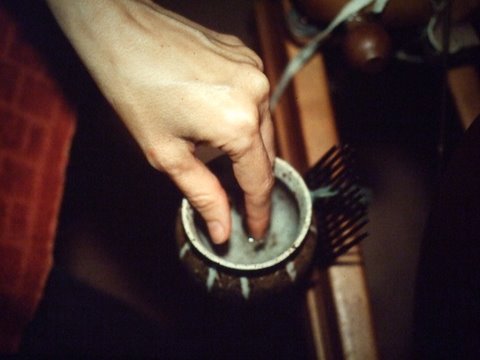
Wet Fingers & Flax Drafting


Wetting my forward hand while the back hand holds onto the point of twist.


Only using my back hand to direct/funnel the fibers to my wet forward hand 


Bringing the twist up the fibers, wetting them at the point of twist.


Q: I watched the Cotton, Silk, and Flax dvd. It was very interesting and helpful. When you were here, you taught me to use one hand for drafting the flax but in the video you use both hands. Did you discover that it was better with one hand? If so, why?

A: Yes, I have learned a great deal more about flax since the video was created. I find I prefer my yarns that have been spun with much wetter hands and more twist than I was using at that time of the DVD.  I try to keep my wet forward hand on the point of twist, (that place where the twist ends and unspun fiber begins), so that I can finger in as many fibers as possible. Wet-spinning the extra twist makes the yarn shinier and less apt to get fuzzy as a finished piece.

This is not the only choice, I have watched other spinners who prefer to alternate their wet hands. However, once the fibers in the drafting zone become wet it is harder to see and guage exactly what is happening. And damp fibers are harder to re-open if that section that has too many or too few fibers.

Here is the sequence, when I wet-spin flax First I need a towel on my lap and perhaps under my extended legs as I drip water everywhere.
  1. Staying out away from the orifice, I hold the point of twist with my back hand while I wet my finger and thumb of my front hand.
  2. Then I replace my wet hfingers on the point of twist and move back into the drafting mode. The back hand lightly funnels the fibers, but the distaff is actually holding the flax.
  3. Then when my fingers are still damp but no longer wet, I re-place my backhand on the point of twist while I reach forward and wet my front finger and thumb.
It is rather seamless now that I have repeated it so often. I usually continue to treadle while exchanging hands and wetting my fingers.  I also wet my fingers when I am plying. During plying I keep my wet front index finger between the plys and my thumb and middle finger on each side. Since the back hand is tensioning the two plys, I rewet my front hand when I have brought the twist all the way back on the tensioned plys and while I am moving the plied yarn into the orifice.  Although I prefer wet-spun yarn, it is easier for new students to start spinning flax with dry fiber so you could see the drafting process and guage how much twist is needed, before beginning to wet-spin flax.
PatsyZ

What type of dye do you use?

Q. What type of dye do you use? I have Procion fiber reactive dyes that I use for another purpose, and the instructions say they can be used with wool. I dyed two batches and it seemed to come out okay, but on the various spinning sites I've visited I have seen no mention of Procion dyes.

A: I use both fiber reactive and acid dyes for my wools. The difference seems to be that if you use the correct amounts of dye, vinegar and heat, the acid dyes can actually exhaust the dye pot so that all of the dye bonds to the fibers. Then the dye pot water will be almost clear.

However, you can't use acid dyes with any plant fiber, like cotton, flax, hemp or ramie, so I keep both kinds of dyes. If I am traveling and need to dye both animal and plant fibers in the same workshop, I will carry my fiber reactive dyes. They bond to cellulose/plant fibers when an alkaline like washing soda is added and they bond with protein/animal fibers when an acid like vinegar is added. But fiber reactive dyes also bond with the water so the dye pot never exhausts. Traditionalists always insist on acid dyes for protein and fiber reactive for cellulose.

Do you have any advice for plying?

Do you have any advice for plying? I have started spinning again after leaving the wheel for many, many years. I'm thinking that these first few bobbins of yarn aren't going to be as uniform as I would like, so plying might make a better overall yarn.


A: Yes plying will usually help an irregular yarn. As far as plying hints go, my simplest recommendation is to ply until the yarn looks good. Of course if you spun Z (clockwise) then you will ply S (counterclockwise). The two parts will nest together and both parts will puff up a bit. If the yarns are under-plied then the two parts, look thready not really nested. If the yarns are over-plied then they both begin to be compressed and get tighter, there will be less definition between the parts. Counting the treadles can help in the consistency but watching closely is best. If you have a double drive wheel then the yarn continues to ply as it is pulled into the orifice. If it is a single drive then you can usually pass the yarn in quickly without adding much plying twist.

It is also helpful to not pass the yarn all the way into the orifice. Stop when the newly plied yarn still extends about 8 inches from the orifice. With your forward hand pinch that spot while you tension the next length so that both parts are equally taut. Then let the plying twist advance up the new length counting and watching the twist. When it looks sufficient let it wind unto the bobbin.

How do I keep from overspinning?

I think my tension problem is just not quite being used to spinning again. I have a castle wheel with a screw adjustment to tighten the tension. I like to run as tight a tension as I can manage in order to keep from overspinning, and I think I've just been too aggressive for my current skill level.

A: What kind of wheel do you have? When you say a castle wheel is it a double drive? That would have one drive band that goes around the drive wheel twice, once on the flyer whorl and once on the bobbin whorl. A single drive wheel has a drive band that goes around the drive wheel and the flyer whorl, and then a separate band that goes over the back end of the bobbin.

It sounds to me as if you need to slightly adjust everything. If you keep your tension very tight then it becomes harder to treadle, and you must treadle faster to keep up your momentum. If you treadle too fast then you get over twist unless you tighten the tension which causes the treadling to be harder.

If that seems to be the case then you need to reverse the cycle. Try this with an empty bobbin and a leader that doesn't slip. When you put the bobbin on the flyer make sure that it spins freely before you put the drive band on it. Also make sure that the large drive wheel spins freely when the drive band is not on it. If either the drive wheel or the bobbins are sluggish then you need to see what is keeping them from moving freely. See if you can fix it. A good oiling may be all you need, but if the wood has warped a round file will fix the inside of a bobbin.

When everything spins freely then put the drive band on making sure you are on your slowest drive speed. It would be the largest drive whorl on your wheel. Then pull the leader through the orifice and hold on to the leader. Now, reduce the tension on the drive band so that the flyer slips and doesn't turn when you treadle and hold the leader. Starting at that point you want to slowly tighten the tension on the drive band, while treadling, until the flyer turns and doesn't slip anymore. Now you may need to let go of the leader and let it completely untwist. When the leader is untwisted, check the take up while treadling. This should automatically adjust the tension on the bobbin if it a double drive wheel. You should feel a gentle take up when you move the leader toward the flyer.

If it is a single drive wheel with a separate bobbin adjustment then begin adjusting that knob slowly like I mention in the last note. You may have to go back and forth between adjusting the flyer and then the bobbin. Do all of this with just the leader.

Using a lighter take up tension, will require you to learn to feed or move the yarn into the flyer, instead of having the wheel take the yarn from you. At first it will feel strange but it will allow you to have a greater degree of control over your spinning and to change sizes and amounts of twist when you choose.

What are your recommendations for oiling the fleece before carding?

Do you have any recommendations for oiling the fleece before carding? I used to do a fair amount of spinning, but have not for 30 years. I recently acquired a couple of fleeces from some meat sheep ( I think Columbia). They were dirty enough that they required washing before carding/spinning. I washed and teased the fleece to get out the VM, and could now card. I dyed some of this fleece in the wool. I recall from prior days that I used to spritz cleaned fleece with an oil/water emulsion prior to carding, but in surfing around various shops for handspinners, I haven't found any mention of this. Have the procedures for handling dirty fleece changed?


I think your sense that the information is not out there, reflects the fact that many, many spinners use prepared roving more than their own fleece. The prepared rovings are drier and consequently spinners have become used to spinning drier fibers. It is difficult to say whether it is better or worst for spinning, I just think it is a current trend. When I started spinning in '81, spinning in the grease was the norm. If you washed your fleece then you reapplied oil to get that slippery feeling. Today I use a smaller amount of an oil spray more to control static rather than replace that slippery feeling.

If you would like to use a oil and water spray, I always recommend a 4 parts water to 1 part oil. The type of oil should be something that will wash out easily. Perhaps you would like a baby or body oil, or a vegetable oil.
In my classes some people prefer to use a conditioner and water spray. Again I recommend it to be a 4 to 1 ratio. The conditioner can be a fabric or hair conditioner.
Lay the clean fleece out on a protected table and spritz the air above the fleece so the mist falls on the fleece like a light rain. Roll the fleece up turn it over and spritz the underside. Then let it rest for at least an hour maybe longer. This will give the water time to evaporate and leave the oil or conditioner on the fibers, ready for carding.
When I am using wool combs, I keep my spritzer besides me since the combs seem to create more static. I often need to spritz the wool while I am combing. How much you need will depend on how dry your environment is and the "slippery feel" that you like. I definitely used more spritzing when I lived in dry Colorado than I do now in Illinois.

What do I do about moths?

I have a basket (well, many baskets) filled with yarn. One basket has about ten skeins of handspun and one skein of commercial yarn. The only one that the moths got to is the commercial yarn. Is there any reason for this? I'm disappointed, but not as much as I would be if it were my precious handspun!! Thanks for any thoughts.

It may only be that they came into the house on that skein. If there is a food source the moths don't go very far. But it means that you need to do some serious moth control now.
I believe firmly in strong sunshine and cleanliness. If you have sunshine this time of the year where you live, that is a very quick easy type of control. Lay all of your skeins outside in the sun. Vacuum well inside the baskets and around, the moth eggs look like sandy colored salt grains and the droppings look like ground pepper. If you see that in the bottom of any basket that is where you need extra attention.
You could also just re-soak all of your handspun in hot soapy water in the washer, NO Agitation of course. Leave them for a couple of hours. Then rinse and hang to dry.

What are the best uses for llama and alpaca fiber?

Help, I have just begun spinning but nobody in my guild spins llama or alpaca. When spinning my llama the yarn appears beautiful, but when knitted or crocheted it becomes so dense you could make armor out of it. Any tips you could give me would be greatly appreciated. I own four llamas and three alpacas and want to use their fiber. 

 A: Llama or alpaca fiber, is best when considered like cotton or linen fiber. Since it lacks the crimp and spring of wool, it is harder to use without careful consideration of the knitting or crocheting styles. The yarn can fuzz out as you use it and you can allow some room in the stitches for that, but since it has no memory, you need to search for stitches that are stretchy by themselves. 

If you are a beginning knitter, the garter stitch and seed stitches are good for adding stretch to the fabric. If you are good at lace knitting, then a fine spun alpaca can be very luxurious. It has the advantage of not closing up the holes that you put into your lace work. If you want a more regular knitting yarn size, spinning very fine and making a 3 or 4 ply will put air inside the yarn between the plies. It still won't have much stretch but it won't be as dense. 

If you are crocheting, work with a larger hook and "size" each loop by tightening it on the thick part of the shank then resisting pulling the loop smaller as you work with it. That takes some mental concentration when you first start, but can be very effective, since the body of the yarn will help to hold open the loops later.

What do you think of the Rigid Heddle loom?

I have been spinning for a while and just learned to weave using a Rigid Heddle loom. I was told that I couldn't use my handspun on this loom. But I'm not sure why. And I was also told that this wasn't really weaving, but a child's play toy. 

I would have to completely disagree with your informants about the rigid heddle loom. I think that the rigid heddle loom can provide a great deal of pleasure for handspinners to use their handspun. Here are several reasons why I like the the simple RH loom. 

1. Usually handspuns show off best in a simple weave structure. The RH loom does tabby best. 

2. It is economical, since the thrums are very short. It is reasonable to warp up single projects. I hate to waste great amounts of my handspun on loom waste. 

3. It is a gentle loom for fragile yarns. 

4. You can use a variety of textured yarns in the "slots" and smooth yarns in the holes. Even fuzzy bouclĂ© mohair yarns in the "slots" work great. 

5. Simple warp floats can be accomplished with a stick behind the heddle. The stick can remain in place the whole time, by pushing it back on top of  the warp beam. Then just slide the stick up to the heddle when the floats are desired. 

For the record, in 1985, the handspun wool skirt that won the "National Make it Yourself With Wool" contest was mine, and was woven on my 32 inch wide rigid heddle loom. This skirt was woven with all handspun singles yarns. 

I always liken the rigid heddle to a guitar, a toy in some hands but truly an instrument of quality when learned and treated with respect. Besides it's portability, and low cost are important assets. True it doesnot do everything well, it is not useful for twills, or long yardage. But don't discount it completely.

How do I crochet with my yarns?

I am a pretty good spinner but when I try to crochet with my yarns they split and generally look bad. What am I doing wrong? Someone said I am spinning the wrong way, but this is the way I was taught. Then the person next to her said she never had any problem with her yarns for crochet. 

 A: Twist is a physics thing, and it can be created many different ways. In relation to fibers and yarns it often has to do with winding or wrapping around something. Think about trying to wind up ribbon, do you wind it around the tube or roll it on for the best results? 

When I crochet there is a definite effect on the twist of my yarn. It may very well have to do with the way I hold my hook and catch the yarn and the fact that I am right handed. Each time I circle the hook I create a Z twist. That means I am removing a S twist, and the result is the yarn unplys if it was plied S. 

If you want to see whether or not YOU are inserting or removing twist the way that YOU crochet then use a thin flat ribbon and work several stitches for a few rows. Try chains, single, double, and see what happens. If your ribbon begins to be twisted then look at the direction of the twist. This / is the direction of a Z twist and this \ is the direction of a S twist. I tend to spin fine and softly and crochet with the hook facing me, and the yarn circles the hook in a clockwise direction for each loop. 
Consequently I create 1 Z twist in the ribbon each time I make a loop when I crochet. (four Z twists for an American double crochet). 

For me then it is easier to spin the single S and lightly ply Z so then I get a tighter plied yarn as I crochet. If I know ahead of thim that the yarn will be used for crochet. On the other hand if one spins a medium size wool, plies firmly and usually does only single crochet or chain stitch, you may not notice any thing happening. Try the flat ribbon on any technique where you are wondering about whether you add or remove twist. Like on your ball winder, or your nostespinne or bobbin winder or knitting or embroidery. It is a very concrete way to find out if YOU ARE doing something that is adding or substracting twist. I'd enjoy hearing your results. PS Most (not all) yarn sold as "crochet" yarn has the last twist as a Z. I even saw a chinese crochet yarn where the label noted in English, "notice the Z twist".  A friend was buying for her Aunt, since her Aunt couldn't find good American crochet yarns overseas.

How do I finish cotton/wool yarn?

I just plied up some cotton/wool yarn and now I'm wondering how to finish it. Cotton is boiled to finish, wool should never be boiled. Also, when making a two-ply with one ply of cotton and one ply of flax would you finish these in the singles, before plying? I finished a cotton plied with flax by boiling, and the cotton shrunk to half it's size while the flax didn't. It is very usable, but I was wondering how others finish when plying different fibers. In recent years, fewer spinners are boiling their cottons. I teach and have experimented with several ways of handling cotton. If you want to darken the cotton yarns, Pima can turn creamy, browns and greens can get darker, then simmering is required. However, you can just wash your cotton yarns like any other yarn, in the sink with some detergent. I always wash my cotton and other fine skeins, as twisted skeins. This prevents the twist from shifting too far in the short fibers and drifting apart and from the fine yarns tangling on each other. It will be helpful to run a short yarn through the two loops to keep them from slipping apart. A twisted skein is very easy to wash and if it is cotton, even dry in the dryer. Your next question of finishing blended yarns, depends on the ingredients. When I teach blending I always recommend finishing the yarn with the requirements of the most fragile fiber. However, just as other teachers recommended the "abuse" method - slapping a wet skein around to encourage felting, which in turn felts the wool around all other fibers, every rule or suggestion needs to be considered by the results desired. If the two fibers are in separate plys, then I call it a mixed yarn, and great novelty results can be obtained by the finishing or abuse you give the yarns, since they can independently shrink, or full, but will pull the other ply along. Try a bit and see.