Do you have handspinning questions? Are you looking for answers? Don't worry, Ms Spinster understands and is ready and willing to answer any questions. How do you think she came to be nicknamed: PatsyZ Most Excellent Spinnin' Guru.Calm ?
For help write to Patsy at spins(at)spinninguru.com. Your question and her answer could be posted on this web page.
Use the search tool and category list on the right to find the answer to your question.
On Sunday, 7/26, I'll be teaching Handspinning Hemp & Ramie, the other bast fibers. In class we will be concentrating on blending, spinning and plying these long cellulose fibers. Hemp and ramie come as tops and rovings and don't require a distaff. They are great for summer shawls, tops, placemats or towels.
I love PLY Magazine for their new perspectives and added dimensions. PLY showcases multiple points of view and many issues are dedicated to single topics. Beautiful to read and to hold, all most all of the photos are staged and taken by PLY's own photographer, Bernadette Emerson.
In the Spring Flax 2018 issue, I was fortunate to author two articles and an opinion on the Hot Button question. "Twist on Flax" and "Finishing Flax" hold several of my tips for working with flax fibers.
Other writers filled in the starting and drafting articles. Here is what I would add. I'm a firm believer in spinning from long line strick for the finest flax/linen yarns. In workshops I help the students recognize how helpful the distaff is. It becomes an extra helping hand, your backhand to hold the fibers. This frees your usual backhand to for new tasks. The first task for the back-hand is holding the twist to keep it out of the fibers while the forward hand dips into the water pot for wet-spinning. The second task is traffic controller, managing unruly fibers only when needed.
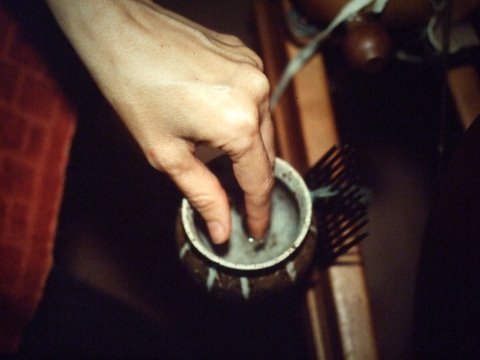
In this video, you will see how my backhand replaces my front hand allowing me to wet my fingers then I continue wet spinning my flax with my wet forward hand. The backhand just holds the twist so it doesn't move further into the fibers until the front hand has time to re-wet.
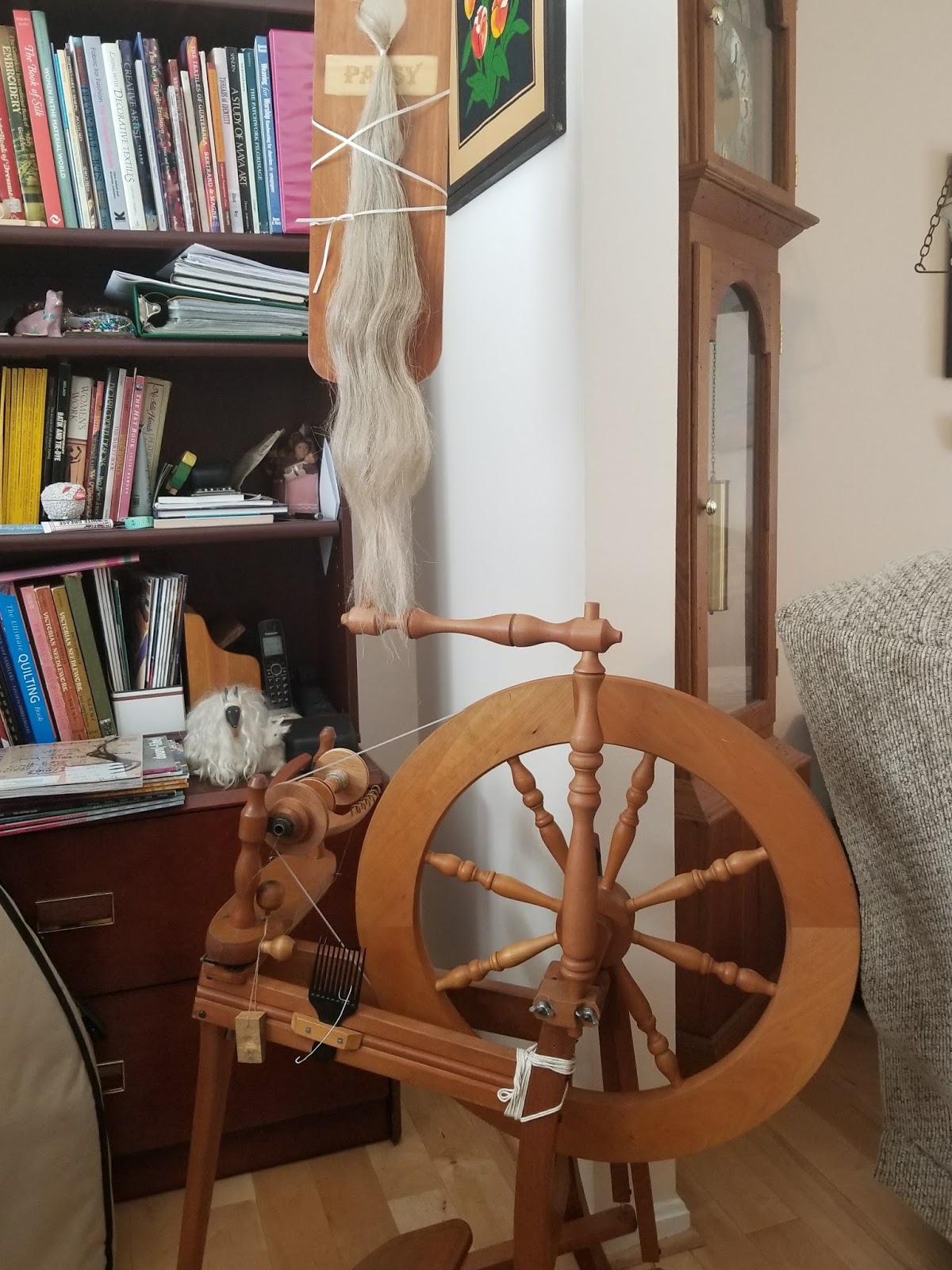
I always keep my fibers under control and prefer to draft the fibers as they move straight down from the distaff. My favorite style of dressing the distaff is the ponytail. This requires a very tall distaff. It is helpful if it is adjustable as you will spin the longest fibers first and over the spinning day you will be working with ever shortening fibers.
A distaff can be created many ways, it is a truly utilitarian tool. Sometimes it was only a peg on the wall near where the spinner sat. Sometimes there was a hole in the chair seat that held the distaff beside the spinner. Sometimes it is a stand-alone tall rack like a coat rack. Many times it is attached to the wheel with a 3 piece arrangement that gives some adjustment to the placement.
My brother made an adjustment to where the Ashford distaff attached to the traditional wheel. Instead of attaching to the front leg, mine attaches to the side leg nearest my knee. (Below there is more information on exactly how it was created.) The distaff I'm using is a handmade paddle style that is extra tall. This is what works best for me.
Some of my students like drafting from the middle of the fibers and I recommend tieing both ends of the stick to make a loop. The loop is helpful if you have a very short distaff. Below you can see how the fork is attached with a rubber band and is used to hold the top of the tied fibers.
Attached fork
Flax loop
A variety of distaffs
Below are a few different stand-alone setups. That you can try. The base can be a Christmas tree stand, a dress form stand, a coat rack, or a music stand. The uprights can be a dowel or even a handle from a broom or "swifer" style cleaning tool. In class I often use a plastic fork taped or rubber banded to the top.
The far right is a lovely oak birdcage or basket distaff made years ago by Rick Reeves. If you have someone who can do some woodwork this is a lovely style to try and copy. Start with a small stool, drill a hole to attach a long pole. The basket is bent basket reeds.
Since I prefer to draft from the end of a ponytail, I usually use it without the birdcage.
If you have a Traditional Ashford wheel and your backhand is your right, here are photos of how my holder was shortened so that I could attach it to the wheel upright.
The full setup with a paddle distaff
Shortened clamp
Clamped to the upright
The original clamp was longer and made to fit on the front leg and hold the distaff to the left of the spinner. Be creative experiment with different styles, once you know exactly how and where you like your distaff, then you can have someone make one to fit your style.
Just an explanation of the white cord below the distaff holder, I keep my extra long drive band for when I use this wheel as a double drive, with a diferent mother of all. Teachers are like that!
Wetting my forward hand while the back hand holds onto the point of twist.
Only using my back hand to direct/funnel the fibers to my wet forward hand
Bringing the twist up the fibers, wetting them at the point of twist.
Q: I watched the Cotton, Silk, and Flax dvd. It was very interesting and helpful. When you were here, you taught me to use one hand for drafting the flax but in the video you use both hands. Did you discover that it was better with one hand? If so, why?
A: Yes, I have learned a great deal more about flax since the video was created. I find I prefer my yarns that have been spun with much wetter hands and more twist than I was using at that time of the DVD. I try to keep my wet forward hand on the point of twist, (that place where the twist ends and unspun fiber begins), so that I can finger in as many fibers as possible. Wet-spinning the extra twist makes the yarn shinier and less apt to get fuzzy as a finished piece.
This is not the only choice, I have watched other spinners who prefer to alternate their wet hands. However, once the fibers in the drafting zone become wet it is harder to see and guage exactly what is happening. And damp fibers are harder to re-open if that section that has too many or too few fibers.
Here is the sequence, when I wet-spin flax First I need a towel on my lap and perhaps under my extended legs as I drip water everywhere.
Staying out away from the orifice, I hold the point of twist with my back hand while I wet my finger and thumb of my front hand.
Then I replace my wet hfingers on the point of twist and move back into the drafting mode. The back hand lightly funnels the fibers, but the distaff is actually holding the flax.
Then when my fingers are still damp but no longer wet, I re-place my backhand on the point of twist while I reach forward and wet my front finger and thumb.
It is rather seamless now that I have repeated it so often. I usually continue to treadle while exchanging hands and wetting my fingers. I also wet my fingers when I am plying. During plying I keep my wet front index finger between the plys and my thumb and middle finger on each side. Since the back hand is tensioning the two plys, I rewet my front hand when I have brought the twist all the way back on the tensioned plys and while I am moving the plied yarn into the orifice. Although I prefer wet-spun yarn, it is easier for new students to start spinning flax with dry fiber so you could see the drafting process and guage how much twist is needed, before beginning to wet-spin flax.
PatsyZ

 On Sunday, 7/26, I'll be teaching Handspinning Hemp & Ramie, the other bast fibers. In class we will be concentrating on blending, spinning and plying these long cellulose fibers. Hemp and ramie come as tops and rovings and don't require a distaff. They are great for summer shawls, tops, placemats or towels.